Q-Notes #002: Why AI Understands Your Texts Differently Than You Think
Expect your stakeholders to have AI summarize your documents.
Bottom line up front
Your first reader is always AI. Every briefing and every document you send today will be summarized by someone using a language model. This machine decides whether your messages are seen as progress, risk or a problem. It rewards structure, not experience: order, repetition and context. If you ignore this, you leave your briefing to the model.
Why it matters
LLMs don’t weigh things up. Language models break your texts into blocks, give heavy weight to the beginning and the end, and condense everything into a few sentences. These sentences end up in search results, AI assistants and media research. An unfortunate ending or a harsh word in the wrong place is enough to push a balanced picture toward “problem case.” A person can put this into context. The machine cannot.
What this means for your communication
Intro: Start with a clear, positive key message that states what has been achieved and how the overall situation should be assessed.
Context: Only mention risks and sensitive points together with figures, examples and measures. Never use stand-alone “alarm claims” without context.
Outro: End with an explicit conclusion that combines opportunities, risks and measures into a clear overall assessment.
The facts: How AI summarizes long texts
These mechanisms are key in practice:
- Chunking: Long texts are broken into blocks. Each block is summarized separately, with its own weighting.
- Attention basin: AI gives a high attention score to the beginning and end of a text. This sets the tone of the summary.
FAQs
How does AI summarize long texts?
It breaks long texts into several blocks, known as chunks. Each section is read and summarized separately before an overall summary is created. Each chunk brings its own weighting, including possible distortions.
What does AI look for when analyzing content?
Among other things, it looks at how often terms appear, strong wording, position in the text and recurring patterns in the structure. The first sections get a particularly high attention score, as do clear structural signals such as headings, bullet points and interim conclusions. As a result, small passages with critical wording, especially at the beginning of a chunk or in the outro, can seem more important than your key positive messages. Whatever is placed prominently there or sounds “loud” is very likely to end up in the summary.
What role do the intro and outro play?
For AI, they are the strongest relevance signals:
- First impression = “What is this about?”
- Last impression = “What do I take away?”
This is why they strongly shape the tone and direction of the summary.
How was the analysis conducted?
We tested real press releases and reports in several leading LLMs and compared the summaries they produced. We then changed only the structure (BLUF, order, outro) and had the texts summarized again. The result: structural changes alone reliably shifted the perceived tone toward “more critical” or “more confident.”
How is this different from human reading?
People use experience, background knowledge and context from outside the text. AI does not have these in the same way and relies more on patterns, position and word choice. That is why text structure becomes strategic: it helps decide what AI later understands as “your” message.
For more content like this, subscribe to our Substack.
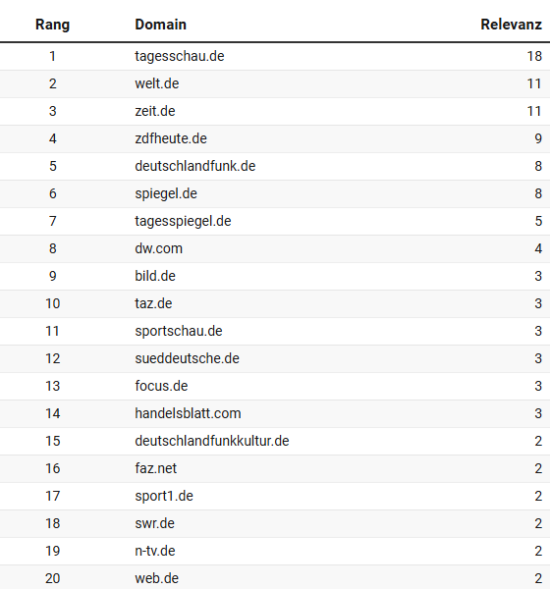
“Tagesschau” remains the most frequently cited source by language models, but the rankings behind it have shifted: welt.de has jumped from 11th to 2nd place.…

Bernstein Analytics GmbH presents its second quarterly analysis of how large language models use sources. The relevance of traditional media in the age of AI…
Insights from the LLM Citation Ranking Bottom line up front Your current media strategy falls short. AI chatbots such as ChatGPT and Gemini act as…

Can a multi-billion-euro transport project, backed by two state governments and the federal government, fail because of the Dahme-Spreewald district administration? It can, as the…

Sometimes things don’t work out the way you think. While a current legislative procedure edged closer to the finish line in the European parliament, one…