AfD District Administrators: Risks and Realities for Business Owners
Can a multi-billion-euro transport project, backed by two state governments and the federal government, fail because of the Dahme-Spreewald district administration? It can, as the history of BER Airport shows, even though flights did eventually start. But would this have happened if Steffen Kotré of the AfD had been the district administrator (Landrat)?
Why should business owners care? Airports are not the only projects that need permits from the district administration. Wind farms, logistics centers and factories need them too, to name just a few. District administrators can have a lot of influence over whether and how quickly these permits are granted. But is this a real risk? We analyzed the question and built a risk model.
District elections and the Alternative for Germany
Fortunately for BER’s shareholders, Kotré only ran for district administrator in Dahme-Spreewald in 2023, and fortunately he lost. However, this outcome was not certain, as he was the strongest candidate in the first round. Like Kotré, ten other AfD members have made it to a runoff for district administrator since January 2022. In 2023, Robert Sesselmann became the first AfD district administrator, in the Thuringian district of Sonneberg. He may soon have company: on 9 June, many district administrator posts will be filled in Thuringia and elsewhere.
This development could be worrying for business owners, for example in renewable energy and logistics, because district administrators hold the keys to many permit procedures at district level. For example, they approve solar and wind farms. The risk is not only rejection but also delays, which can make projects unprofitable. Thuringia’s environment ministry has also recognized the danger that AfD district administrators and mayors could further slow down the energy transition in a state that is already lagging behind. According to the news platform “The Pioneer,” the ministry plans to take this responsibility away from districts and municipalities by ministerial ordinance.
District administrators pose not only a regulatory risk but also a reputational one. What should a company do if the AfD district administrator wants to celebrate the topping-out ceremony for its new logistics center together with the company? At least parts of the party are classified as confirmed right-wing extremist. How does the election affect local skilled workers and recruiting? Companies need to prepare for these difficult questions now. Once elected, a district administrator stays in office for at least four and sometimes up to ten years. For companies, it is therefore very important to understand when and where AfD candidates could be elected, and how likely this is, in order to assess their investments and site development.
How likely is it that AfD candidates will be elected?
Ahead of and alongside the European elections on 9 June, district administrator posts will be filled in Thuringia, Lower Saxony and some other parts of the country. Next year, district elections will follow in North Rhine-Westphalia, Mecklenburg-Western Pomerania and Rhineland-Palatinate. By December 2025, one third of all districts will have replaced their top administrative official. In 2026, Bavaria will also elect new district administrators across the state.
For companies and investors, the good news is that the risk of an AfD district administrator is rather low in the vast majority of districts. With a Bayesian regression model, we can use local structural characteristics and historical election data to estimate the probability of an AfD win for each district. The less good news is that there are still districts where the probability is high enough that companies must prepare for all scenarios. The model classified 13 districts as elevated risk. These include Erzgebirgskreis, the districts of Görlitz, Zwickau and Stendal, and Altenburger Land, where an AfD candidate is also standing for election on 26 May 2024. Based on current data, the model gives this candidate a 35 percent chance of winning. Eleven other districts have a low risk, and in 224 districts an AfD win is virtually ruled out.
What should companies do if an AfD candidate wins the next district election?
In summary, strong AfD mobilization in district elections is a risk for local business owners that should not be underestimated. These developments require careful monitoring and preparation by management in order to respond to possible changes in local politics and administration. Business owners, especially in the 20 districts with a probability of more than 20 percent, should prepare with risk assessments and scenario planning and secure support from supervisory boards and shareholders early on. They should decide how to respond if the district administrator asks for a joint photo at the groundbreaking for a plant expansion. And they should ask themselves whether they can communicate all of this to their current and future employees.
Are you facing these questions and need support? Feel free to contact Julian Schibberges.

People love talking about people. So it is hardly surprising that the media is currently fixated on the question of who might replace Chancellor Friedrich…
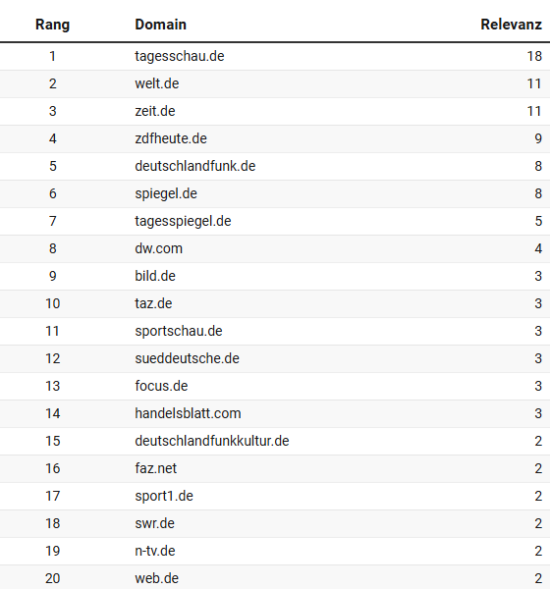
“Tagesschau” remains the most frequently cited source by language models, but the rankings behind it have shifted: welt.de has jumped from 11th to 2nd place.…

Bernstein Analytics GmbH presents its second quarterly analysis of how large language models use sources. The relevance of traditional media in the age of AI…

Expect your stakeholders to have AI summarize your documents. Bottom line up front Your first reader is always AI. Every briefing and every document you…
Insights from the LLM Citation Ranking Bottom line up front Your current media strategy falls short. AI chatbots such as ChatGPT and Gemini act as…

Sometimes things don’t work out the way you think. While a current legislative procedure edged closer to the finish line in the European parliament, one…