Q-Notes #001: LLM Citation Ranking: How AI Is Changing Strategic Communication
Insights from the LLM Citation Ranking
Bottom line up front
Your current media strategy falls short. AI chatbots such as ChatGPT and Gemini act as invisible gatekeepers and control which messages get through. This makes them digital key opinion leaders. They pass on knowledge and shape new narratives through their answers. In this way, they set the standards for how opinions are formed.
Why it matters
Leading media alone no longer give you control over how issues are interpreted. LLMs filter, interpret and summarize information before your target audience sees it.
Language models are not neutral. Their answers depend directly on the data behind them. This is why the choice of sources decides which narratives become visible.
Algorithm first. This fundamentally changes the rules of the game. Don’t just convince journalists. Make yourself relevant to algorithms as well.
What this means for you: Think “AI first”
AI-compatible content: Write press releases and statements so that language models can process them easily and are likely to cite them. Provide clear facts and precise wording, and publish on reputable platforms.
Rethink communication patterns: Staying quiet and waiting things out used to work. If your perspective is missing online, even a short denial, AI models will adopt other people’s views.
The facts: What the Bernstein Analytics LLM Citation Ranking shows
We analyzed 3,000 answers from the four leading AI models (ChatGPT, Gemini, Perplexity, Grok). The results are a wake-up call for every communications professional:
- The new opinion leaders: tagesschau.de and spiegel.de clearly lead the ranking. A placement here has the greatest direct influence on AI-generated answers and therefore shapes the information ecosystem.
- Bias is real: The choice of sources shows political leanings. ChatGPT cites conservative media twice as often as left-liberal media. Gemini prefers left-liberal sources at a ratio of 3:1.
- Loss of control: Traditional German media make up only about 25% of the sources AI models use. The rest consists of international news, specialist publications and other online content that many communications departments hardly follow.
FAQs
What is the LLM Citation Ranking?
The LLM Citation Ranking is an analysis by Bernstein Analytics GmbH. It measures how often and to what extent leading AI chatbots (large language models) use content from specific media as sources when generating answers.
Why is a ranking like this important?
Traditional measures of media relevance, such as circulation or reach, fall short. Information behavior has changed fundamentally: more and more users get their information directly from AI chatbots instead of visiting traditional news sites. As a result, many portals are already seeing drops in traffic. The ranking shows which media are cited and have influence in this new AI-driven information environment.
Which media are the biggest winners of the LLM Citation Ranking?
The undisputed top 3 in the overall ranking of the most-cited German media are:
- tagesschau.de
- spiegel.de
- fr.de
How was the analysis conducted?
The analysis is based on 3,000 answers from the four AI models ChatGPT, Gemini, Perplexity and Grok. We created 750 standardized prompts (30 per topic) on 25 relevant topics from five news sections, including business and domestic and foreign policy. A media monitoring tool was used beforehand to identify these topics as the most discussed of the last quarter.
Do the AI models show ideological tendencies (bias)?
Yes, the analysis shows clear differences in the models’ ideological preferences.
- ChatGPT prefers conservative media (36.4%) over left-liberal media (18.4%) at a ratio of almost 2:1.
- Gemini shows the opposite tendency and prefers left-liberal sources (32.5%) over conservative sources (10.5%) at a ratio of about 3:1.
What exactly counted as a citation?
The analysis only included sources that the AI model explicitly listed in the source references for its answer. Media that were only mentioned in the body of the answer were not counted.
How were the AI models’ raw data made comparable?
Since the models list very different numbers of sources, the raw data were standardized using a z-transformation. This method puts all values on a common scale and shows how much a source differs from the average. The final ranking is based on the mean of these standardized values.
Which AI models were examined?
We used the standard versions of each platform that are available without a user account. At the time of the study, these were:
- GPT-5 (with web search)
- Gemini 2.5 Flash
- Grok 3
- The latest version of Perplexity
When will the next LLM Citation Ranking be published?
The next Bernstein Analytics LLM Citation Ranking will be published in mid-January 2026.
For more content like this, subscribe to our Substack.
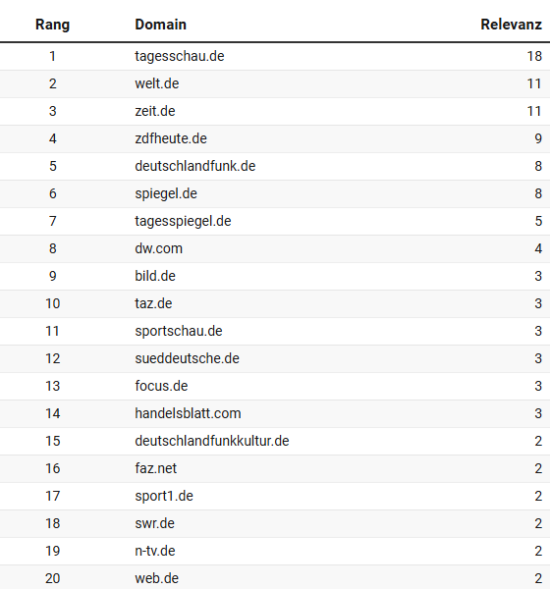
“Tagesschau” remains the most frequently cited source by language models, but the rankings behind it have shifted: welt.de has jumped from 11th to 2nd place.…

Bernstein Analytics GmbH presents its second quarterly analysis of how large language models use sources. The relevance of traditional media in the age of AI…

Expect your stakeholders to have AI summarize your documents. Bottom line up front Your first reader is always AI. Every briefing and every document you…

Can a multi-billion-euro transport project, backed by two state governments and the federal government, fail because of the Dahme-Spreewald district administration? It can, as the…

Sometimes things don’t work out the way you think. While a current legislative procedure edged closer to the finish line in the European parliament, one…