Sectoral Ministers’ Conferences: An Underestimated Cog in the Machine
During the COVID-19 pandemic, the Conference of Minister-Presidents (MPK) moved into the public spotlight. Before that, it had largely gone unnoticed by the general public. The same is still true, perhaps even more so, for the other sectoral ministers’ conferences of the federal states. Yet they and the cooperation between the states that they involve are worth a closer look. There is good reason why Dr. Claus-Peter Clostermeyer, long-time head of Baden-Württemberg’s representation in Berlin, says the sectoral ministers’ conferences play a role “for legislation and administration in the Federal Republic that can hardly be overestimated.”
In principle, horizontal and vertical cooperation play an important role in Germany’s federal system. The sectoral ministers’ conferences are part of this. They are a voluntary, horizontal form of cooperation between the states, are used for coordination within individual policy areas and adopt joint decisions. Besides the relevant state ministers, the federal level is also involved. In many conferences, the relevant federal ministry attends as a permanent guest. In addition, the policy spokespeople of the governing majority in the Bundestag take part in the preparatory meetings of the A-states (SPD-led) and B-states (CDU-led). This benefits both sides, since each level stays informed about the political plans of the other. The conferences can sometimes even be the decisive forum in policy areas where, formally, the federal government alone has legislative competence. On topics such as the digitalization of public administration, it would be unwise not to reach agreement with the states in advance. This happens in the sectoral ministers’ conferences and gives the states a good opportunity to influence the project.
At the same time, the conferences are used for intensive coordination among the states on decisions and voting in the Bundesrat. Given the sheer number of decisions the Bundesrat has to make, this coordination is simply necessary. It allows technical issues and possible majorities to be explored at an early stage of a legislative project. States can share specific concerns with other states and seek support for their proposals. The states also pool their individual strengths this way. Hesse, for example, has expertise in banking and aviation, while the coastal states are the experts on maritime issues.
Given this importance and impact, it becomes clear that the political make-up of the conferences also matters a great deal. It is especially interesting when the party-political make-up of a conference does not match the majority at federal level, that is, when a party in opposition at federal level dominates a sectoral ministers’ conference.
One example is the Building Ministers’ Conference (BMK), the conference of state ministers responsible for construction. The figure below shows that state ministries responsible for construction are more often held by the CDU than other relevant ministries. The CDU has already taken advantage of this.
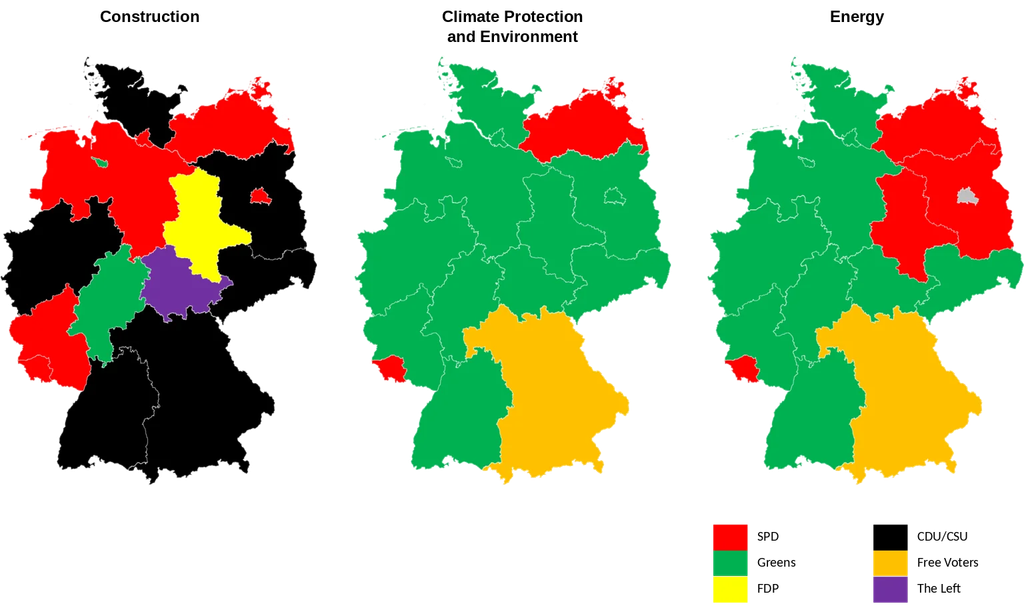
Figure: Party affiliation of the state ministries responsible for construction, climate protection, energy and the environment
The BMK regularly sends important signals to the federal level and is often willing to seek conflict. Building energy is a good example. The states play a very important role here, even though the area is mainly governed by federal law. This is even more true at the moment, as the newly created Federal Ministry for Housing, Urban Development and Building is still being set up and has fallen behind in important discussions with the states. The BMK has used this situation, for example by taking a clear position against abandoning the energy efficiency principle and by setting up a working group to develop a concept for including life-cycle emissions in regulation. This shows how well the states can coordinate their positions on important issues. The BMK has also made clear to the federal government that it does not see decarbonizing the building stock as an overriding goal, but as equal in importance to creating affordable housing.
Looking at the sectoral ministers’ conferences from this angle shows that the real line of conflict in the federal system does not always run between the federal government and the states. On building energy, it runs between the federal government and the CDU-led state ministries. This shows how important and influential the sectoral ministers’ conferences are in German federalism, and why their role can hardly be overestimated.

People love talking about people. So it is hardly surprising that the media is currently fixated on the question of who might replace Chancellor Friedrich…

Can a multi-billion-euro transport project, backed by two state governments and the federal government, fail because of the Dahme-Spreewald district administration? It can, as the…