The Traffic-Light Coalition and the Opposition: Who Has Settled into Their New Role Better?
The September 2021 federal election also shifted the balance of power in the German Bundestag. This change comes with new roles for the parliamentary groups. The CDU/CSU parliamentary group is in opposition for the first time since the 2002 election, while the Greens are part of the government again for the first time since the 2005 election. After about seven months of the traffic-light coalition and with the start of the parliamentary summer break, it is time to analyze how far the CDU/CSU group has settled into its new role, and how effectively the traffic-light coalition, the first of its kind at federal level, is working.
The CDU/CSU in its new role as opposition
Ultimately, only the actors themselves can answer whether the CDU/CSU group has settled into its new role as opposition. We do not want to assess the content of its work. However, the opposition has various tools at its disposal, which can have different effects on political or media debates and procedures. We have picked out two as examples.
- First, we look at the number of written parliamentary questions (Kleine Anfragen). Parliament uses them to ask the federal government to explain certain matters or answer specific questions, in order to create public attention and starting points for further debate.
- Second, we look at the number of motions (Anträge) a parliamentary group has introduced. Unlike written questions, motions are policy proposals drafted by the parliamentary groups. The opposition often uses them to present alternatives to draft laws or to plans in the coalition agreement.
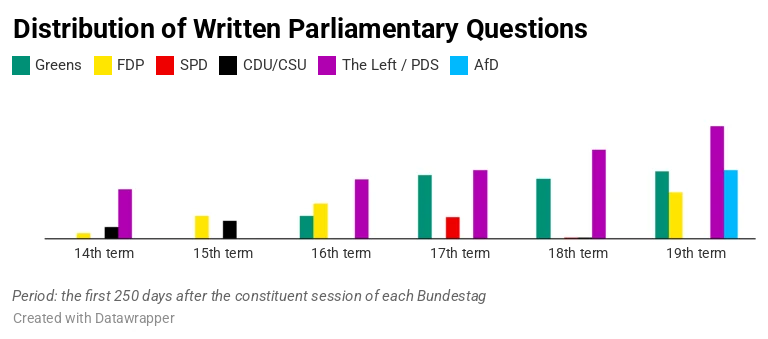
So far in the 20th Bundestag, the CDU/CSU group has submitted the fewest written questions. Groups more familiar with opposition work (e.g. the Left) show much higher numbers. Over the period studied, two general observations can be made:
- Groups that stay in opposition over several legislative terms (e.g. the Greens from 2009 to 2017) submit a rising number of written questions over this period. This suggests that it takes time for MPs and their staff to master this parliamentary tool.
- The reverse is also true: groups that are new to opposition submitted noticeably fewer written questions in the comparison period.
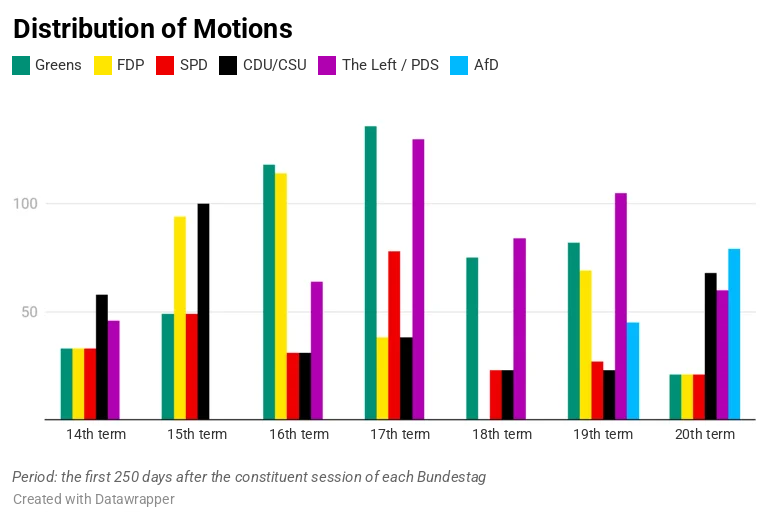
For motions, the picture is more mixed. This parliamentary tool is also used much more by the governing groups. Looking at individual motions shows that these groups use them to set thematic priorities and to formulate political positions and demands on broader issues. Groups that are new to opposition submit motions more often than written questions. One possible explanation is that most MPs and staff are used to drafting political motions from years of party work. It can also be argued that motions are more similar to draft laws than written questions are. It therefore seems likely that MPs and groups that were part of the government in the previous legislative term can draft motions more efficiently than written questions. The CDU/CSU group is no exception in the current legislative term. In relative terms, it submits far more motions than written questions and is among the most active groups in parliament in this category.
The traffic-light coalition in government: how well is the legislative process working?
In assessing the work of the traffic-light coalition, we again look at structures rather than evaluating content. In this case, we look at how many bills the federal government introduced in the Bundestag in the 200 days after the election of the Federal Chancellor and the swearing-in of the cabinet. In theory, more bills introduced at this early stage should indicate that the new government works together more effectively and smoothly and can therefore achieve a high legislative output. The ambitious and comprehensive coalition agreement should also support this goal.
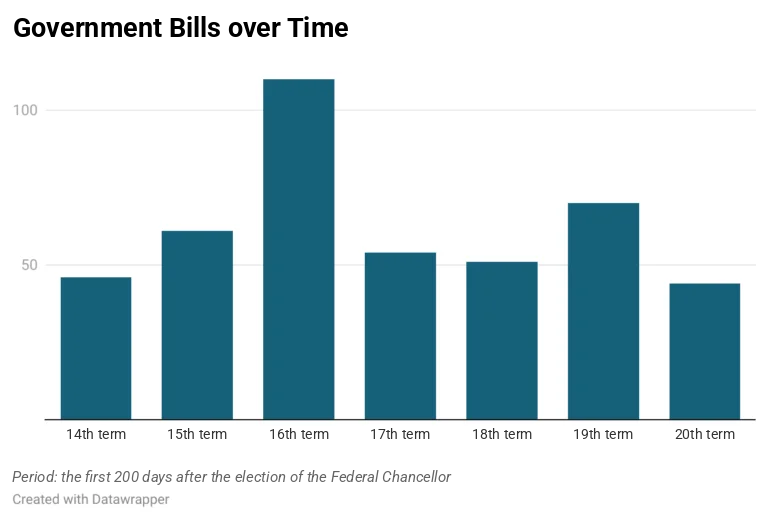
It is striking that the current traffic-light coalition has the lowest output of all the coalitions examined in this period. Based on the assumption above, the numbers suggest that the coalition still has to find its best way of working together, at least as measured by output. However, if you compare the current output of the first three-party coalition, where coordination is much more demanding than in previous alliances, with that of previous governments (e.g. Schröder I, Merkel II and Merkel III), the number of bills introduced is not significantly lower. It can therefore be argued that, despite being a coalition working together in this form for the first time, the current government is performing at a level comparable to its predecessors.
Conclusion
This data-based look at the initial questions shows that it is much more challenging for parliamentary groups at the start of their time in opposition to get used to the (changed) work of parliament. They either have to do without resources (fewer MPs, fewer staff, no access to ministries) or first build them up (training MPs and staff, setting up structures). As a result, the number of written questions, and therefore scrutiny of the government’s work, is below average at the beginning.
Based on the figures examined, the transition into government seems to be easier for new governments. There are differences in output here too, but they are generally smaller. One explanation could be that when a new government is formed, only the political leadership in the ministries changes. The civil servants who prepare legislation stay in place, which ensures that the executive keeps functioning smoothly and that legislative work does not have to be learned from scratch every time. Nevertheless, the current coalition has the lowest output (so far) in historical comparison. This can be explained by the fact that three parties are part of the government for the first time and by the very volatile political environment.

People love talking about people. So it is hardly surprising that the media is currently fixated on the question of who might replace Chancellor Friedrich…