Lower Saxony State Election: How Does the Result Affect the Bundesrat?
Lower Saxony has voted. Last Sunday, just over 6 million eligible voters were called to cast their ballots. Despite losses, Stephan Weil’s SPD clearly won the election and plans to form a coalition with the Greens. After the four state elections of 2022 in Saarland, Schleswig-Holstein, North Rhine-Westphalia and Lower Saxony, we take a look at the composition of the Bundesrat. How has the distribution of votes there changed? And what does the 2023 election year mean for the balance of power in the “parliament of the state governments”?
According to the preliminary official result, the SPD is the clear winner of the Lower Saxony election with 33.4%. Compared with the last state election in 2017, this is a loss of 3.5 percentage points. The CDU suffered significant losses, winning only 28.1% of the vote compared with 33.6% in the last election. As expected, the Greens achieved a record result, nearly doubling their share from 8.7% to 14.5%. The AfD also nearly doubled its result, from 6.2% to 10.9%. With 4.7%, the FDP failed to enter the state parliament for the first time since 1998. The Left, with only 2.7%, again failed to clear the 5% threshold, as in 2017.
As for forming a government, the red-green coalition favored by both the SPD and the Greens has a majority. Together, they have 81 seats, clearly more than the 74 of 146 seats needed. Continuing the grand coalition of SPD and CDU would also be possible with 104 seats, but neither party is currently seriously pursuing this.
The Lower Saxony election was the fourth and last state election this year. Saarland, Schleswig-Holstein and North Rhine-Westphalia had already voted in spring. One overall trend emerges from the 2022 elections: in Schleswig-Holstein (Daniel Günther, CDU), North Rhine-Westphalia (Hendrik Wüst, CDU) and Lower Saxony (Stephan Weil, SPD), the appeal of the sitting minister-presidents and the incumbency bonus that came with it were decisive. In Saarland, Anke Rehlinger (SPD) was “only” economy minister and deputy minister-president. But she benefited not least from the perceived weakness of incumbent Tobias Hans (CDU) during the campaign. Once again, strong and well-known personalities are better at mobilizing voters. Especially in times of crisis like the current one, when trust and stability are needed more than ever, this seems to matter a great deal to voters.
New balance of votes in the Bundesrat: SPD “rids itself” of the CDU
For the Bundesrat, the 2022 election year also had federal-level effects that should not be underestimated. With Saarland (3), Schleswig-Holstein (4), North Rhine-Westphalia (6) and Lower Saxony (6), 19 of the 69 votes in the Bundesrat were up for grabs. For the CDU, losing its role in government in Lower Saxony is already the second loss of Bundesrat votes this year. At the end of March, the CDU had to hand over government in Saarland to the SPD. For the Bundesrat, the election results mean that the number of states led or co-governed by the CDU/CSU continues to shrink. Before the 2022 state elections, they co-governed ten states. Now only eight remain. The CDU/CSU’s votes in the Bundesrat fall accordingly from 48 to 39.
The SPD did not gain any Bundesrat votes in 2022, but it managed to “rid itself” of the CDU in both Saarland and Lower Saxony. This means the last two remaining grand coalitions at state level are now history. The SPD is still part of the government in eleven states and now has a say over a total of 42 Bundesrat votes.
The Greens greatly increased their influence in the Bundesrat in 2022. Before April 2022, the party was part of ten governments. Soon it will co-govern in twelve of the 16 states. This makes its role in the Bundesrat more and more central: after four state elections this year, the Greens have gone from 41 to 49 votes. This means they are not involved in only 20 of the 69 votes in the Bundesrat.
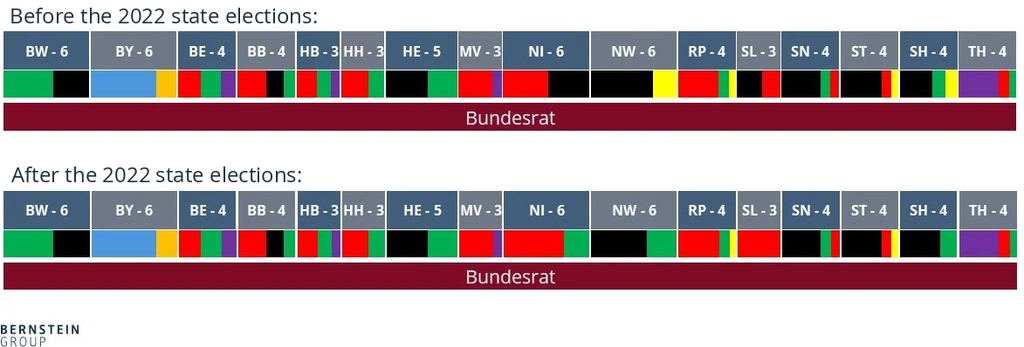
Figure: Distribution of seats in the Bundesrat before and after the 2022 state elections
For the traffic-light coalition, the state elections in Saarland and Lower Saxony are especially good news, as they make it easier to push through legislation with the help of the states in the Bundesrat. The more states are firmly in the hands of the SPD or the traffic-light parties, the less coordination is needed with the states. Eight states (Berlin, Brandenburg, Bremen, Hamburg, Mecklenburg-Western Pomerania, Lower Saxony, Rhineland-Palatinate and Saarland) with a total of 30 votes will in future count as so-called A-states (SPD-led), which are unlikely to oppose the traffic-light government. The Greens will co-govern in six of these A-states. Only in Brandenburg does the CDU still have influence over how an A-state votes. Thuringia is formally not an A-state, since its government is led by the Left, but two parties that govern at federal level, the SPD and the Greens, are also part of the government there. This means the traffic-light coalition can more or less count on up to 34 Bundesrat votes for laws that require Bundesrat approval. In addition, the role of Baden-Württemberg, the only Green-led state, should not be underestimated, as it can make the difference if in doubt. The SPD still does not have a secure absolute majority in the Bundesrat, but it came much closer to one in 2022. The so-called B-states (CDU/CSU-led) will in future include only six states with a total of 29 votes: Bavaria, Hesse, North Rhine-Westphalia, Saxony, Saxony-Anhalt and Schleswig-Holstein. For completeness, Baden-Württemberg should also be mentioned here, since its votes could in principle give the B-states the necessary absolute majority of 35 votes as well.
More state elections will follow in 2023, including in two B-states, Bavaria and Hesse. At the moment, it is not expected that the balance of power in these states will change so fundamentally that the CDU/CSU loses its lead over the SPD. But the fast pace of politics can cause even majorities that seemed safe to suddenly wobble. For example, the Greens could become the only possible coalition partner for the CSU in Bavaria if there is no longer a majority for an alliance with the Free Voters. The Greens, as part of the traffic-light government, would then be directly involved in another heavyweight state in the Bundesrat. The SPD’s share of votes in the Bundesrat could also change next year. For the Bremen state election on 14 May 2023, it is currently not expected that the red-red-green coalition will be voted out. However, a fourth election in 2023, which has not yet been confirmed, could be added and at least force the SPD to hand over an A-state to the Greens: Berlin. The final decision of the state constitutional court on repeating the election is still pending, but there is a good chance that voters in the capital will have to go to the polls again after the electoral chaos. In current polls for the Berlin House of Representatives, the Greens are sometimes well ahead of the SPD, which is why Franziska Giffey would have to fear for her job as Governing Mayor of Berlin if new elections are held. So things remain exciting, not only in the state parliaments, but also when it comes to the balance of power in the Bundesrat.
Image by Thomas Ulrich on Pixabay.

People love talking about people. So it is hardly surprising that the media is currently fixated on the question of who might replace Chancellor Friedrich…

Can a multi-billion-euro transport project, backed by two state governments and the federal government, fail because of the Dahme-Spreewald district administration? It can, as the…