Negotiating Structures in the Council and the Underestimated Role of Attachés in Council Working Parties
The findings discussed here are based on expert interviews conducted in Brussels with members of the EU working parties on health and published here as part of an academic article.
Political procedures in the European Union are above all a question of competence. People often associate the European Union with the institutions based in Brussels. But it is much more of an umbrella term for the European Commission. EU member states remain sovereign states that pool this sovereignty in some policy areas, sometimes only in parts of them, in order to gain influence by acting together.
Health policy is a good example of such a policy area. Here, the Commission only has a so-called “supporting competence,” meaning it can only support, coordinate or supplement the measures of EU countries. That is why EU health policy mainly takes place within the Council, as the (coordination) platform of the member states[1].
How the Council works: top-down vs. bottom-up
The Council meets in ten different configurations, in which the relevant ministers of the member states come together to amend or adopt legislation. The Council also negotiates documents without legal effect, such as conclusions, resolutions and declarations.
The ministerial meetings are prepared by the “Comité des Représentants Permanents” (Coreper), the Committee of Permanent Representatives. Coreper is divided into Coreper I and Coreper II, depending on the subject of the dossier. Contrary to what one might expect, the numbering does not indicate a hierarchy. In fact, Coreper II prepares the more important, political dossiers, while Coreper I prepares the work of the additional, more technical Council configurations. Each EU member state is represented in Coreper by a Permanent Representative (Coreper II) and a Deputy Permanent Representative (Coreper I). They head the member states’ Permanent Representations to the EU in Brussels and have the rank of ambassador.
In reality, however, only about 15 to 20 percent of agenda items are left to Coreper. The ministers themselves deal with only about 10 to 15 percent. It is the Council working parties, the third level of this negotiating ladder, that “pre-cook” around 70 percent of decisions, to use EU jargon. When analyzing and assessing EU policy and intergovernmental dynamics in the negotiating process, it is therefore essential not to focus first on the bottleneck, but on the work and interaction of the working parties responsible for a dossier[2].
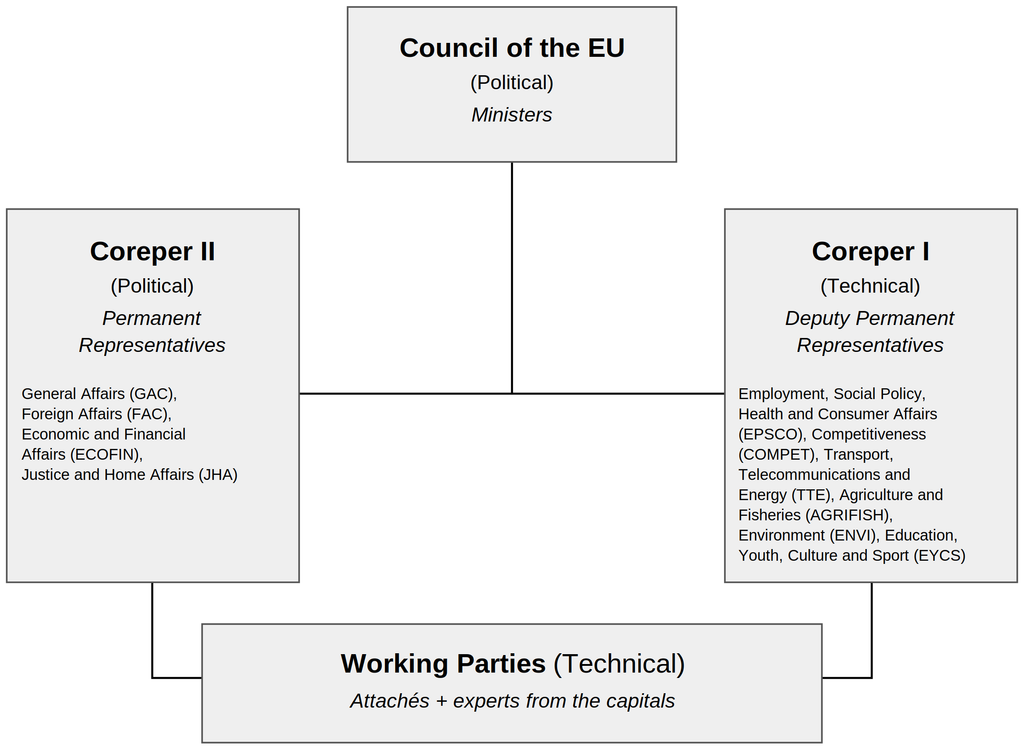
The institutional architecture of the Council. Source: Author.
The Council working parties bring together so-called attachés, the diplomats of the member states’ Permanent Representations to the EU. They attend the meetings together with experts from their capitals. However, attachés are usually not career diplomats. While the Permanent Representatives and their deputies are sent by their countries’ foreign ministries, the attachés in the working parties are seconded by the relevant national ministries.
The Permanent Representations also differ clearly from other diplomatic missions because they cover far more policy areas than a normal embassy. An EU health attaché generally represents all subject areas of their health ministry. On average, these amount to 60 to 75 departments, about half of which produce EU-relevant output.
Large, “old” member states have at least two attachés per Council configuration, while small, newer member states are usually understaffed. This affects their negotiating position, especially because EU diplomacy differs from classical diplomacy. The Council is a legislative body, so a thorough knowledge of both the EU and the national legal framework is essential and requires building up a lot of expertise. If all of this falls on one person, there is little time left for informal negotiations and for winning support for one’s own position.
An EU attaché’s daily work in five roles
Information gatherer and transmitter
Attachés collect specialist information in and about Brussels, especially on the positions of other member states and the EU institutions on legislative proposals. This information is sent as reports or written comments in one direction, via the attaché to the capital, where it reaches the responsible officials, usually in the international or EU affairs departments of the relevant ministry. Collecting and providing information also involves filtering and prioritizing which Brussels topics are relevant for their own ministry.
Attachés from the newer member states are also tasked with setting up regular communication between Brussels and their capital in the first place, since many ministries there are still only marginally interested in the EU. In such cases, a Brussels attaché can have a lot of influence, because they can shape the direction of this new engagement.
Networker and contact broker
Ministries also have their own direct links to other member states and to the Commission, especially at political level. Still, communication between the member states and the Commission usually goes through the Permanent Representations. A large part of an attaché’s daily work therefore involves connecting colleagues in national ministries with the EU institutions or with their counterparts in other member states. Especially in crises, quick contact with many countries is necessary, and attachés are ideally placed for this. After the outbreak of the COVID-19 pandemic, officials in the capitals quickly asked their attachés in Brussels for contacts, for example: “Who can I contact in the French ministry, the Dutch one, the Austrian one or the Italian one?”
Early warning system
Being close to both the member states and the EU institutions makes attachés useful antennas for their capitals. Close contact with the Commission is especially important. As “guardian of the treaties,” the Commission monitors whether member states comply with their EU obligations. Attachés therefore quickly learn about possible friction between the Commission and a member state and pass it on to their capital: “If there is criticism, you hear it fastest in Brussels.” The same applies to legislative proposals initiated by the Commission. Attachés can flag a proposal that runs against national interests early on, in order to work against its publication by the Commission.
Representative and advisor
Attachés do not only pass on information, contacts and warnings to their capital. They are national delegates sent to Brussels to present and defend their country’s position as well as possible. However, the room for maneuver differs here as well. Some attachés even write their own instructions. Others, as their colleagues confirmed in interviews, “wouldn’t even go to the toilet” without instructions from the capital. Eastern European countries in particular have a long tradition of red lines and little freedom to shape positions.
Negotiator
Together with national experts, attachés go through proposals “article by article, chapter by chapter” to find out where differing interests need to be negotiated. Balancing these interests often leads to the formation of blocs. First, like-minded countries on a specific issue come together, in formal or informal, multilateral or bilateral meetings. Then they approach the countries that are not like-minded as a common front. The majority wins.
In the ordinary legislative procedure, the European Parliament is co-legislator on the same dossier as the Council. Attachés therefore often attend workshops and conferences on the dossier organized by Members of the European Parliament. This is a strategic opportunity for both sides. As one attaché put it frankly: “You go there and say something for five minutes about how important the topic is. This then allows us to ask for something in return later in the trilogue, for example if we need help convincing colleagues of the importance of a certain article.”
Recommendation and outlook
In legislative processes involving the Council, stakeholders tend to focus either directly on the ministerial level or at least on Coreper as the decision-maker. This first look at the structure and daily work of the working parties has shown that it is more advisable to understand which topics and challenges are already being “pre-cooked” at working party level in order to make your position heard. This is especially true because the attachés of the EU-27, through their daily interaction, feel a political obligation to cooperate and find solutions. This affects their role as representatives and advisors and as national negotiators on draft legislation.
A follow-up post will look at these socialization processes within the Council working parties and beyond. Among other things, it will explain why the Permanent Representatives in Brussels are often called “permanent traitors” (a play on “Ständige Vertreter,” Permanent Representatives), especially in Berlin.
[1] An overview of the policy areas in which the Commission can adopt legislation “exclusively,” “shared” or “supporting” can be found here.
[2] An overview of all Council working parties can be found here.

Trilogues are interinstitutional negotiations between the Commission, the Council and the Parliament. They are not explicitly mentioned in the EU treaties, yet they have become…

Sometimes things don’t work out the way you think. While a current legislative procedure edged closer to the finish line in the European parliament, one…
In February 2023, we already looked at the underestimated role of Council working parties and their members, the national diplomats at EU level (attachés). We…